History
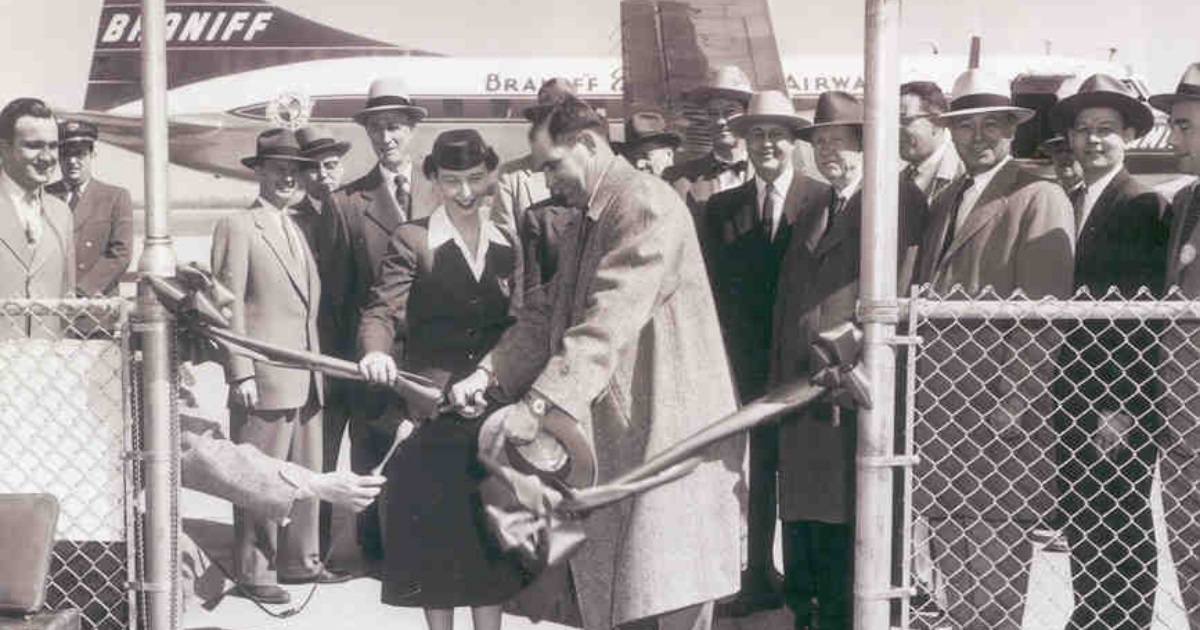
Air Capital Terminal 1 (ACT 1), which is now the Kansas Aviation Museum, operated 19 years, from 1935 – 1954. Construction began June 1929 on the administration building of the Wichita Municipal Airport, now THE present day Kansas Aviation Museum. With the crash of the Stock Market and the start of the Great Depression in 1930, it took another five years before the building opened in 1935.
Air Capital Terminal 2 (ACT 2) – Wichita Municipal Airport/Wichita Mid-Continent Airport – April 1954 – May 2015. In January 1951, the Air Force established a Base at the Wichita Municipal Airport. Construction soon began on Wichita Mid-Continent Airport. See Brick and Tile 1954 for historical pictures.
Air Capital Terminal 3 (ACT 3) – Wichita’s third terminal building opened on June 3, 2015 with much fanfare and media attention. The first departure was on United Airlines; the first arrival was on Southwest Airlines. The first month of service saw a 6% increase in passengers. Learn more about the Air Capital Terminal 3.
Download Wichita Airport History to learn more.
Airport Name Change to Wichita Dwight D. Eisenhower National Airport
The name, Wichita Dwight D. Eisenhower National Airport, pays tribute to President Eisenhower who considered Kansas his home state. On October 8, 2013, a citizens group called Citizens for Eisenhower Airport presented a petition with 1,573 signatures to the Wichita City Council in favor of renaming the Wichita Airport to Wichita Dwight D. Eisenhower International Airport. Learn more about the Airport Name Change.
The Story Behind the Airport Statue of General Dwight D. Eisenhower
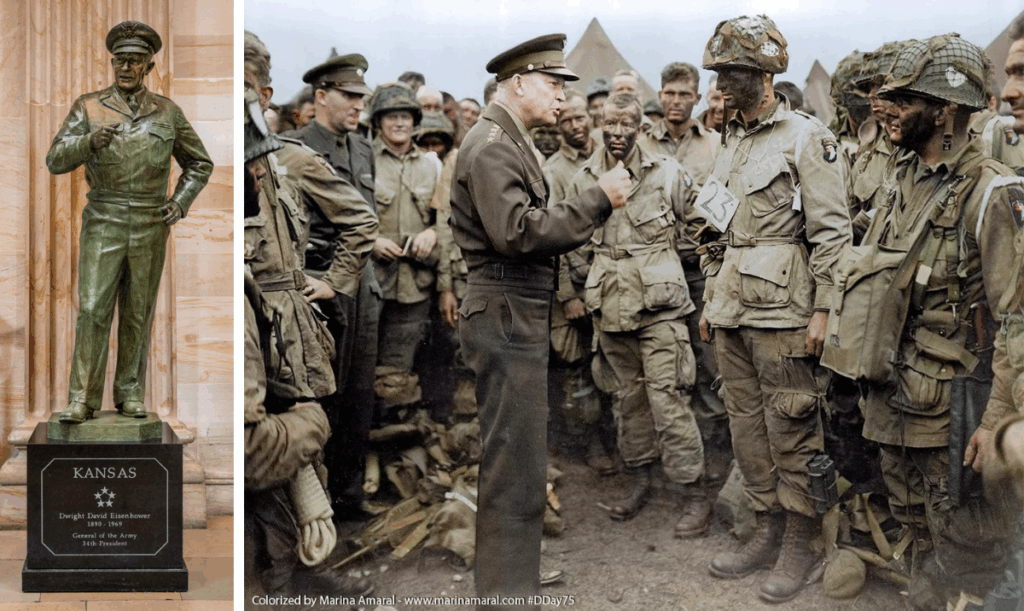
The Airport’s statue of General Dwight D. Eisenhower is a replica of the one displayed in the U.S. Capitol’s National Statuary Hall. Former Congressman Todd Tiahrt played a key role in bringing this statue to the airport.
This statue captures a pivotal moment: General Dwight D. Eisenhower addressing paratroopers of the 101st Airborne Division on the eve of the D-Day invasion in June 1944. In the original photograph, Eisenhower appears serious and focused, gesturing with his right hand as he speaks to the troops. But artist Jim Brothers uncovered a surprising detail—Eisenhower was telling a story about fly fishing. “He’s got an invisible fly rod in his hand,” Brothers said. “In that one day, he went from the most powerful, to me, to the most human that he probably ever was.”
About the Artist
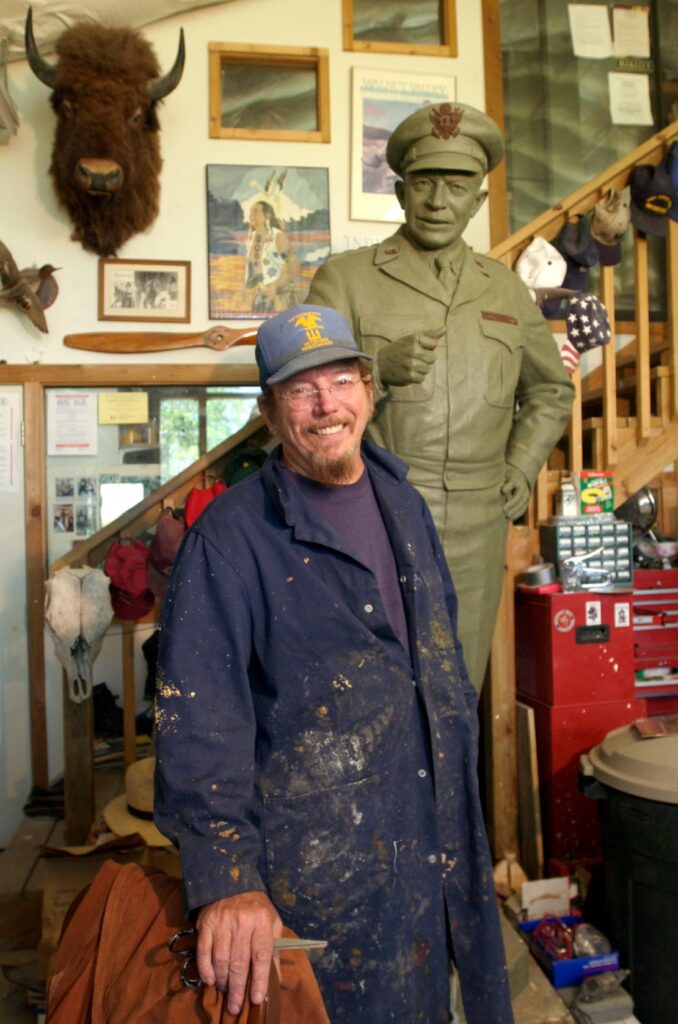
James (Jim) E. Brothers (1941–2013) was born in Eureka, Kansas, and spent much of his life in Lawrence. He gained national recognition for his powerful bronze sculptures, particularly those honoring American soldiers. His most famous works include several pieces at the National D-Day Memorial in Bedford, Virginia, which was dedicated by President George W. Bush on June 6, 2001. Brothers created this statue of Eisenhower using a clay model, later cast in bronze. A few ¼-scale versions were also commissioned to support the creative and fundraising process—one of which is displayed here alongside a photo of Brothers with the original model.
Eisenhower’s Journey
Dwight D. Eisenhower was born in Texas in 1890 and moved with his family to Abilene, Kansas when he was less than a year old. A graduate of the U.S. Military Academy at West Point (Class of 1915), Eisenhower desired to lead troops in France, but because of his skills as an instructor, he was kept stateside during World War I. He rose steadily through the ranks and in 1942, Eisenhower was named Supreme Commander of Allied Forces in Europe. Following the successful D-Day invasion, he led Allied troops through to victory in Europe. Eisenhower later served as president from 1953 to 1961, winning two terms with broad public support and the memorable campaign slogan, “I Like Ike.” He died in 1969 and is buried in Abilene, Kansas. This airport was renamed in his honor in November 2014.
Bringing Ike to the Capitol
The presence of Eisenhower’s statue in the U.S. Capitol is thanks to the efforts of Congressman Todd Tiahrt of Kansas. After touring the Capitol with his parents in 1995, Tiahrt was inspired to see Eisenhower honored in the National Statuary Hall Collection—a privilege granted by an 1864 law allowing each state to contribute two statues of notable individuals. Until then, no state had ever replaced one of its original statues. Tiahrt led a successful legislative and fundraising campaign to make Eisenhower Kansas’s new representative, replacing Governor George Washington Glick’s statue in 2003. Kansas became the first state to replace a statue in the historic collection.
While only 38 of the 97 statues in the collection are housed in Statuary Hall itself, the rest are displayed throughout the U.S. Capitol. Eisenhower’s statue remains a permanent and powerful presence in the hall.
Learn more about Eisenhower, sculptor Jim Brothers, and Congressman Todd Tiahrt’s efforts to honor Kansas’s most famous son by viewing this video.
Historical Pictures