


The hardest part of planning milestone and multi-gen trips usually isn’t picking the destination. It’s the money conversation nobody wants to start. One sibling earns more than another. Grandma’s 80th birthday deserves something memorable, but nobody wants to be the person who says “that’s out of our budget” in the family group chat. The good news is that affordable multigenerational travel is possible. Families do this every year without resentment, and the ones who pull it off follow a few predictable patterns: they anchor on real numbers early, they name a cost-splitting model out loud, and they concentrate the celebration budget on one signature moment instead of spreading it thin.
Multigenerational travel is also more common than most planners realize. Industry research from the Family Travel Association and AARP’s annual travel trend surveys consistently shows that roughly 40 to 50 percent of family travelers plan trips including three generations, and the trend keeps growing. If you are organizing a trip with grandparents, adult siblings, and grandkids, you are in the mainstream, and there are established norms you can borrow instead of inventing everything from scratch.
For families flying out of Wichita Dwight D. Eisenhower National Airport (ICT), the math works in your favor more than you might expect. ICT’s nonstop routes on American, United, Delta, Southwest, Alaska, and Allegiant connect directly to some of the best group-travel destinations in the country. We’ll flag those throughout.
What a Multi-Gen Trip Really Costs
A realistic budget for a domestic multigenerational trip runs about $800 to $1,400 per person for a week, assuming a shared vacation rental, drive-to or short-flight travel, and mostly home-cooked meals. Resort and cruise tiers run higher, typically $1,500 to $2,500 per person. That upper range matches national data: Bankrate’s annual vacation cost surveys put the average domestic week-long vacation at roughly $1,500 to $2,500 per person depending on destination and season.
Why does this baseline matter so much? Because most family trip conflicts start with colliding assumptions. One household pictures a $600 lake weekend. Another pictures a $3,000 beach resort week. When those assumptions surface after emotional commitments are made, someone feels either cheap or priced out. A shared price anchor, stated before any destination debate, is the single best defense against later resentment.
Affordable does not mean $100 motels and gas station sandwiches. It means understanding which lodging model drops the per-person cost as headcount rises. Hotels charge per room, so costs climb with every family added. Large vacation rentals charge per property, so costs fall with every family added.
Sample Budgets by Group Size
The table below compares approximate per-person weekly lodging costs for three common models. Numbers assume a $4,200/week large villa rental, a mid-tier all-inclusive resort at $250 per adult per night, and a mainstream 7-night cruise at $900 to $1,200 per person.
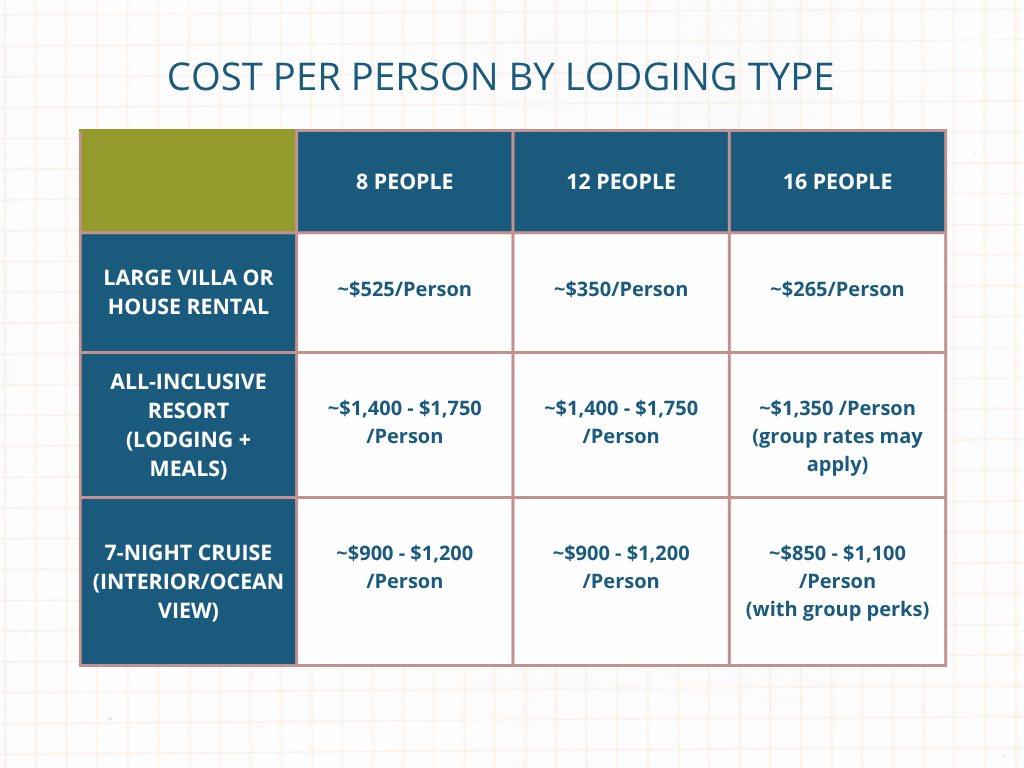
Cost by Lodging Type Per Person
Notice the pattern: villa costs drop sharply as the group grows, while resort and cruise costs stay mostly flat because they price per person. A group of 16 in a rental pays roughly a quarter of what a group of 8 pays per head for the same house. This is the core reason big family trip budgets can beat couple-trip budgets on a per-person basis.
Where the Money Actually Goes
A typical multigenerational trip budget breaks down close to 40 percent lodging, 30 percent transportation, and 30 percent food and activities. That distribution tells you which lever moves the total most. Lodging is shared, so the rental model attacks the biggest line item. Airfare is the stubborn one, because every traveler pays individually. A family of twelve flying from Wichita pays twelve fares no matter how clever the lodging plan is, which is why drive-to destinations from Wichita, like Branson, the Ozarks, or Colorado, dominate budget multi-gen planning, and why ICT’s nonstop routes matter for fly-to trips.
Watch the hidden costs that scale with headcount: cleaning fees on rentals, resort fees, gratuities on cruises, and restaurant bills for parties of twelve. These are the expenses that make family trips “always cost more than expected.”
Key Takeaway: Set the per-person budget before the destination, not after. A shared number like “$1,000 to $1,200 per person, all in” lets every household opine from the same baseline instead of colliding assumptions after emotions are invested.
How Families Typically Split the Cost
There is no single right way to split a family vacation, but there are established norms, and naming one out loud prevents the silent resentment that ruins the memory more than any dollar amount ever could. The most common real-world arrangement: grandparents cover the lodging, and each adult household covers its own airfare, meals out, and extras. AARP’s grandparenting and travel research has consistently found that a majority of grandparents contribute significantly to multigenerational trip costs, often covering the shared house or resort as a gift [Source: AARP Travel Research]. Many boomers frame this explicitly as inheritance-now thinking: spending on shared experiences with the family while everyone can enjoy them, rather than leaving the money later.
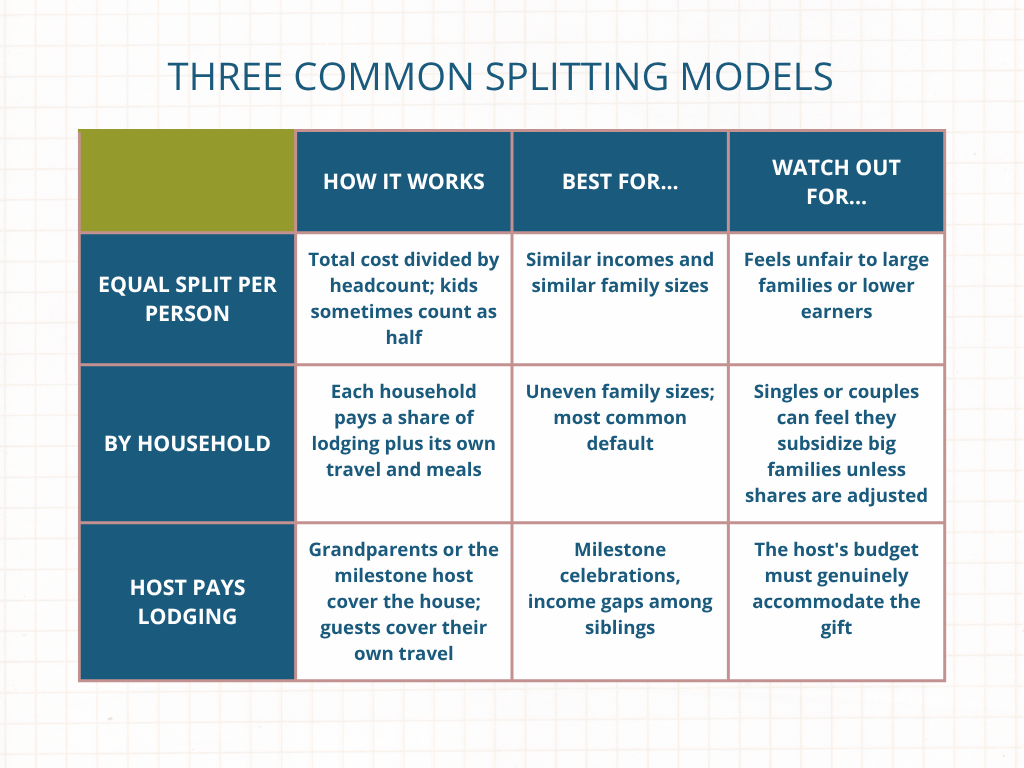
The Three Common Splitting Models
Room-assignment politics deserve one sentence in your plan too: the household taking the master suite pays a slightly larger share than the household in the bunk room. Pricing rooms proportionally resolves the argument before it starts.
Handling Income Gaps Gracefully
The deepest anxiety in group trip planning is exposure. Nobody wants their financial situation visible to their siblings. A few discreet mechanisms let households spend differently without anyone’s finances being on display:
- Anonymous budget polls. A free Google Form asking “what per-person budget feels comfortable?” lets everyone answer honestly. Plan to the lowest comfortable number, because pricing anyone out defeats the purpose of a togetherness trip.
- Tiered room pricing. Within a villa, the master suite costs more and the bunk room costs less, so budget-conscious households choose cheaper rooms without explanation.
- Opt-in excursions. Keep the core trip affordable and make the deep-sea fishing charter or spa day optional add-ons. Skipping an excursion is normal; skipping the whole trip is painful.
Having the Money Conversation Without a Feud
The money conversation goes wrong when it happens late, verbally, and vaguely. It goes right when it happens early, in writing, with one clear proposal and a private way to say “that’s too much.” Nobody should have to admit financial strain in front of siblings, so the organizer’s job is to build in escape hatches.
Timing matters most. Set the budget before the destination. Once someone has emotionally committed to Maui, walking it back to Branson feels like a demotion. When the budget comes first, every destination proposed already fits.
Booking Moves That Protect the Budget
Large-group affordability is won at booking time, not during the trip. Properties that sleep 10 or more are scarce in every market, and they sell out first, so book big rentals 9 to 12 months ahead, especially for summer and holiday weeks when school calendars force every household into the same dates.
- Prioritize refundable rates. In a group of twelve, someone will have a conflict. Refundable lodging typically costs about 10 percent more than nonrefundable rates, but it protects every family’s deposit when one household has to cancel.
- Use airline group desks for 10 or more travelers. American, United, Delta, and Southwest all offer group booking programs, generally starting at 10 passengers on the same itinerary. Group fares hold pricing while you collect commitments and often reduce or waive name-change fees [Source: American Airlines Group & Meeting Travel]. For a Wichita family flying twelve people through Dallas or Denver, that pricing hold alone is worth the phone call.
- Price travel insurance seriously. Standard trip insurance runs about 4 to 8 percent of total trip cost, and cancel-for-any-reason coverage runs 10 to 12 percent, according to industry data from Squaremouth. Insurance matters more for multigenerational trips because older travelers face higher health-related cancellation risk, and a 50th anniversary happens exactly once.
- Fly midweek from ICT. Tuesday and Wednesday departures from Wichita Eisenhower National Airport routinely price 15 to 30 percent below weekend fares on the same routes, and multiplied across twelve travelers, that difference funds the private chef night.
- Check documentation for skip-gen trips. Grandparents traveling alone with minor grandchildren should carry a notarized consent letter from the parents, and passports if a cruise itinerary touches foreign ports.
Q: How far in advance should we book a family reunion trip for 12 people?
Reserve lodging 9 to 12 months out, because large rentals sleeping 12 or more are the scarcest inventory in any market. Book flights 2 to 6 months out for domestic routes, or contact an airline group desk once you have 10 confirmed travelers to hold a group fare. Collect household deposits before making any nonrefundable payment.
Bring it all together and the path is simple: anchor the group on a real per-person number, choose a destination built for groups, name the splitting model out loud, put it in writing early, splurge on one signature moment, and book defensively. Follow that sequence and the trip your family remembers won’t be the one where money got weird. It will be the one where everyone was there.